
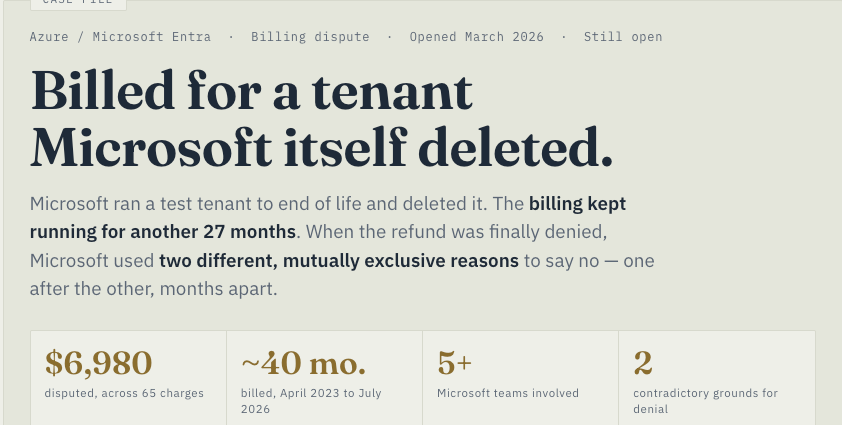
Microsoft ran a partner sandbox tenant to its own scheduled end-of-life and deleted it. The billing for two subscriptions tied to that tenant kept running for 27 more months. When the refund was finally denied, Microsoft used two different, mutually exclusive reasons — five weeks apart.
Executive Summary
- Microsoft deleted a CDX (Customer Digital Experiences) partner tenant at scheduled end-of-life. Two subscriptions tied to it kept billing for 27 more months.
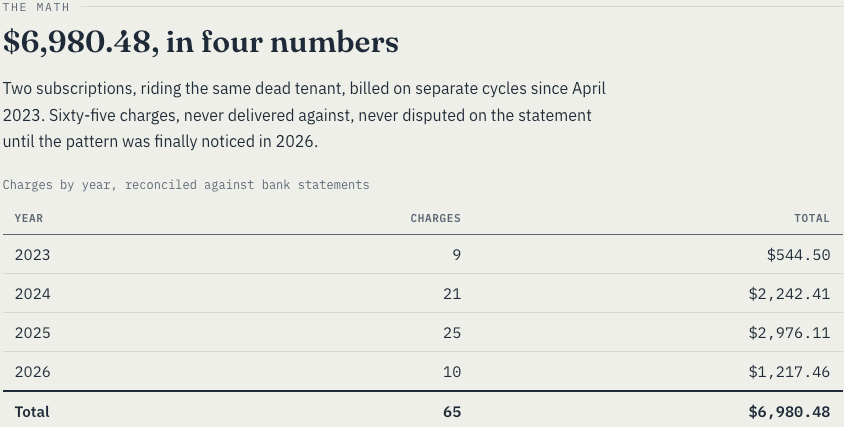
- $6,980.48 across 65 charges, April 2023 → July 2026 — because a deleted tenant leaves no subscription in the admin center to select or cancel, so every support case routes to a team that "sees no active subscription" and closes it.
- The refund was denied twice, five weeks apart, on two different and incompatible grounds — a reporting-window policy first, then a tenant-deletion date that Microsoft's own Entra team had already said wasn't the relevant fact.
- Microsoft's own reporting-window policy holds the customer to roughly 90 days. Microsoft's own team needed roughly 129 days just to stop the billing, once formally notified.
- The takeaway that matters beyond this one case: audit your recurring cloud charges against what's actually still running. The billing does not stop itself.
Read this part regardless of the rest
Microsoft's own refund policy runs on a reporting window described, more than once, as roughly 90 days. Past that window, the position given has been that no refund is available — not partial, not prorated, none — regardless of what caused the charge or how long the service had actually been gone. The window doesn't ask whether anything was delivered. It only asks how fast the bill was noticed.
Sit with the other half of that clock: once this was formally reported, Microsoft's own team — with full internal system access, several specialized groups, months of dedicated attention — needed roughly 129 days just to stop the billing. Not resolve it. Stop it. That's longer than the 90 days it holds the customer to, and it's the team with every advantage the customer didn't have.
If the people who built the system can't move that fast, the window was never really about speed. It's about where the cost of the gap gets decided to land.
The actual lesson, independent of how this resolves: audit your recurring cloud charges against what's actually still running — regularly, not just when a number looks wrong. Deletion doesn't stop billing. Only someone checking does.
How an orphaned tenant bills forever
This started as a Microsoft-run CDX tenant — the partner platform Microsoft itself provisions for hands-on demo and test environments. It reached Microsoft's own scheduled end of life. Microsoft deleted it.
Deleting the tenant also deleted the only place a subscription can be selected and cancelled. There was no admin center, no visible subscription, no cancel button — the tenant did not exist from the customer side. But two subscriptions tied to that tenant kept renewing every month, on a card on file, for years. Every subsequent support case looked up the account, found no active subscription attached to any visible tenant, and closed itself as nothing to fix. The deletion was the reason nobody could find the record — and the reason nobody stopped the charges.
Two denials, five weeks apart, that can't both be true
Denial No. 1 — Azure Billing, August 11, 2026:
"The request was declined because the issue was not reported within the timeframe required under Microsoft's refund review policies."
A reporting-window policy — the rule Microsoft applies when a service was available and simply went unused. This one wasn't available. Microsoft had already deleted it. That window has been described, more than once, as roughly 90 days — past which the position given has been that no refund is available at any amount, regardless of cause.
Denial No. 2 — Azure Billing, September 16, 2026:
"The tenant deletion date was significantly later than the period during which the disputed charges were incurred... any resubmission would likely result in the same outcome."
This time, the tenant deletion date — a completely different fact than the first denial relied on. Microsoft's own Entra engineer had already stated, in writing, five weeks earlier, that the deletion date is not the relevant question; the case turns on when the subscriptions were deprovisioned (April 22, 2024), not when the empty tenant shell was finally deleted (August 19, 2026).
Two teams. Two tests. Neither one applied to a subscription Microsoft's own tools show was shut down on April 22, 2024 — the actual date nothing was left to deliver.
Six months, five teams, one answer that keeps changing
- March 17, 2026 — First support case opened, after noticing unexplained recurring charges. No prior notice of any deletion had ever been sent, to anyone, on any account.
- May – June 2026 — Three more cases, a phone line with no menu option for "billing on a deleted tenant," and a support rep's advice to ask the bank to block the card — for a legitimate business charge, not fraud.
- June 17, 2026 — A support engineer names the four subscriptions on the deleted tenant for the first time in three months of tickets, proving they'd been traceable all along.
- July 24, 2026 — Subscriptions finally cancelled by Microsoft, on Microsoft's own systems. The billing stops. The refund request for everything already charged is opened separately.
- August 11, 2026 — Denial No. 1: reporting window.
- August 24, 2026 — Microsoft's own Entra tools show all four subscriptions Deprovisioned, end date April 22, 2024 — over two years before this ever reached a support ticket.
- September 8, 2026 — Microsoft's Entra engineer states, on the record, that the tenant-deletion date and the subscription-deprovisioning date are separate facts, and the refund question turns on the deprovisioning date.
- September 15, 2026 — Direct written escalation to two support managers, by name. Neither responds.
- September 16, 2026 — Denial No. 2: a front-line rep, not either manager, replies that the case is "final" — using the tenant-deletion date the Entra engineer had already ruled out three weeks earlier.
The math
Two subscriptions, riding the same dead tenant, billed on separate cycles since April 2023.
Where this stands
The only thing that has actually moved is that the two subscriptions were cancelled, so the bleeding stopped. Nothing else has. The refund itself is not being owned or moved by anyone. Two support managers have been asked directly, in writing, whether they agree the case is closed. Neither has answered. A colleague answered for them, with no authority to.
This post will be updated if that changes — in either direction.
Individual support staff are described by role, not named. This is about a process, not a person.
Want more patterns like this?
Get the full 6-part guide — what Intune doesn't tell you, but you'll hit in production.
Running into this in production? 30 minutes — I will tell you directly if it is worth fixing.
Book a Fit Call →